01 / The challenge
More Devices Mean More Network Complexity
A small office may begin with only a few computers and a simple switch. As the company grows,
printers, servers, storage systems, gateways and other wired devices are added. At that point,
a basic unmanaged switch can become limiting because it provides connectivity without much
visibility or control.
02 / Managed networking
The SG3428 Gives Businesses More Control
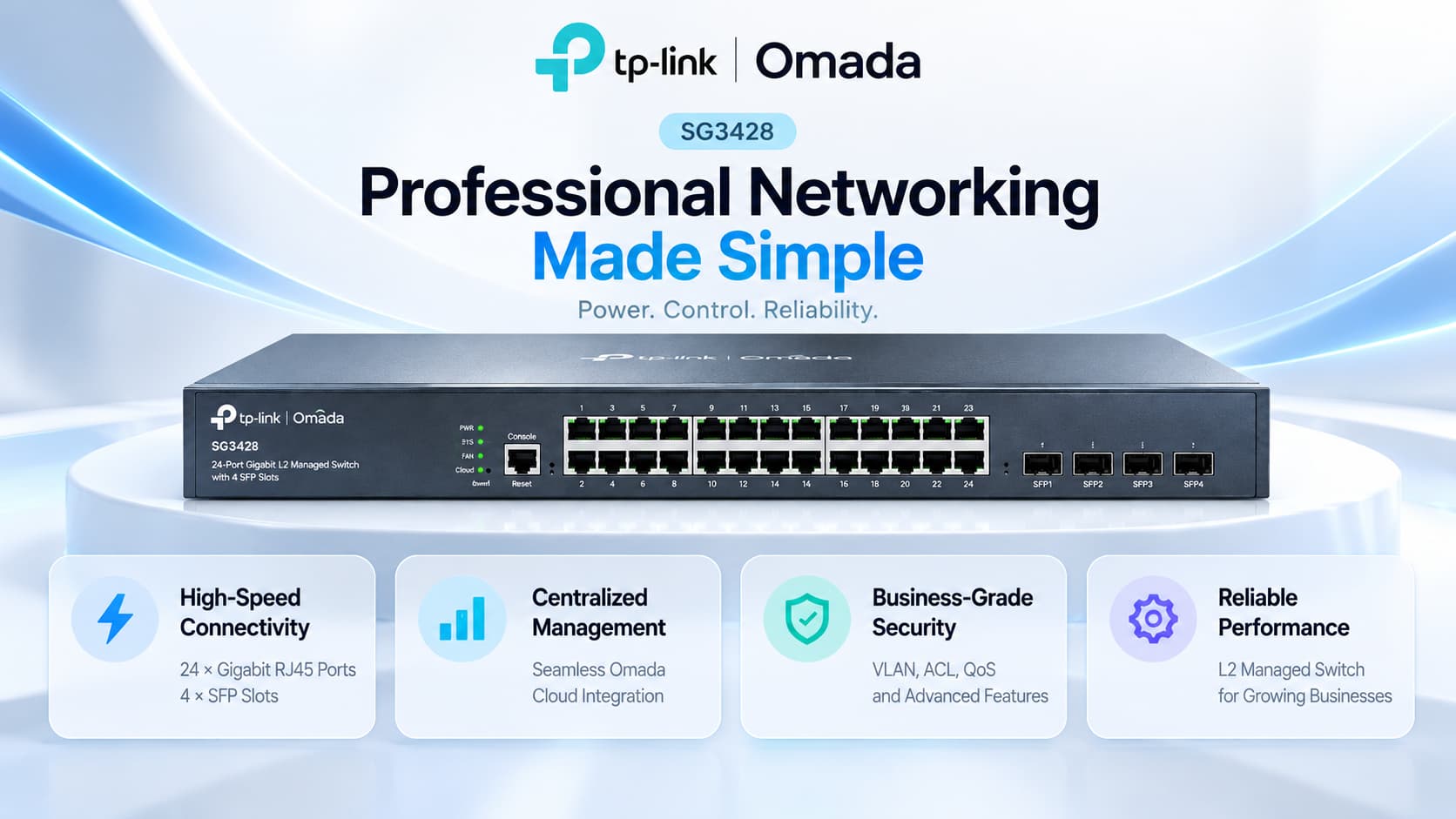
The Omada SG3428 combines 24 Gigabit RJ45 ports with managed Layer 2+ features.
That means the switch can do more than simply connect devices—it can help organize how traffic moves
through the network.
VLAN Segmentation
Access Control Lists
Quality of Service
Static Routing
24
GIGABIT RJ45
4
GIGABIT SFP
03 / Connectivity
Copper for the Office. SFP for Flexible Uplinks.
The 24 Gigabit Ethernet ports provide room for everyday wired devices,
while four Gigabit SFP slots can support compatible fiber or copper modules
for uplinks or longer-distance connections.
A growing network should become easier to control—not harder to understand.
04 / Security
Keep Important Traffic Organized
VLANs can help separate employee, guest, voice, server and operational traffic.
Additional security features such as ACLs, port security, DHCP Snooping and 802.1X
can give administrators more control over access to the wired network.
Employee Network
Guest Network
Voice Network
Server Network
05 / Omada management
Manage Compatible Omada Devices from One Environment
In an Omada deployment, compatible switches, gateways and wireless access points can be managed
through a centralized interface. This can make monitoring, configuration and troubleshooting easier
as the network grows.
Live-Tech Perspective
Who Is the SG3428 Best For?
The SG3428 is a strong fit for businesses that need reliable Gigabit connectivity,
managed network controls and Omada integration without requiring PoE power or 10-gigabit uplinks
from this switch.
Professional offices and growing teams
Server rooms and structured network racks
Retail and hospitality environments
Compatible multi-device Omada networks
Important before ordering
The SG3428 is a non-PoE switch, and its four uplink slots are Gigabit SFP rather than 10G SFP+.
PoE devices require a separate power source, injector or PoE-capable switch.

.jpg)